Our employees, customers and neighbors succeed when we prioritize our ‘Communities are Thriving’ ambition, together.
By serving neighbors and empowering communities for over 50 years, we’ve helped drive lasting change as an engaged partner in the places where we live and work – before, when and after we’re needed.
Now, we’re evolving our social impact efforts under a unified strategy, Generation Go Green℠, to educate, empower and employ the next generation to drive change by sparking curiosity, creativity and action.
Generation Go Green℠
From grade school to trade school and beyond, we’ll help unlock opportunities for youth to learn inside and outside the classroom, open doors to green collar careers and provide intentional ways to make an impact across generations.
Our unified social impact platform features three signature programs to:
Educate
Green Force programs will educate youth through immersive learning, engaging programs and eco-actions.
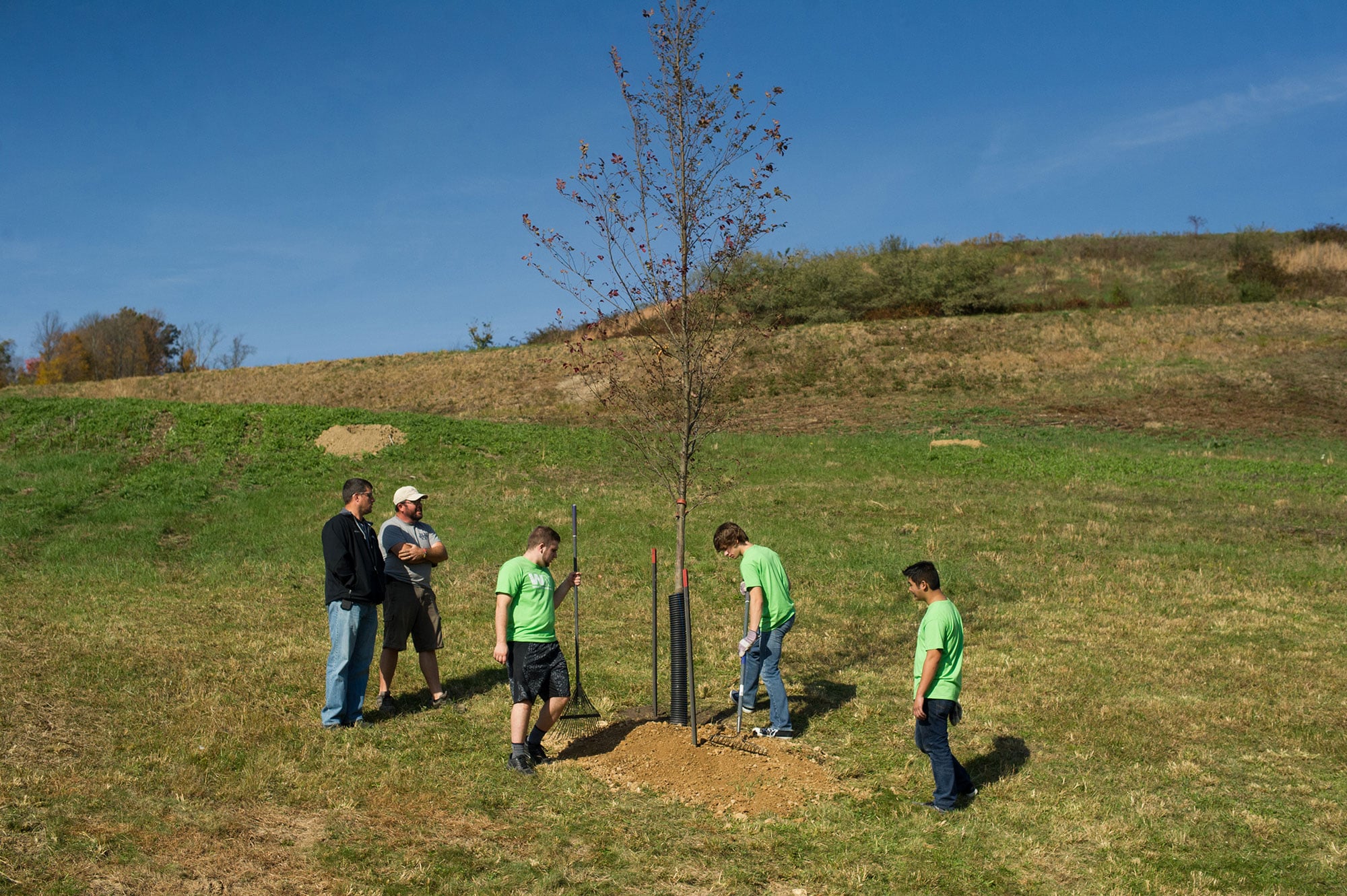
These activities serve as an extension of our continuous efforts to build future leaders by providing access to education in the form of in-or-after school-based programs, youth engagement initiatives, and habitat projects that utilize the outdoors as a classroom.
Learn more about Generation Go Green℠ on our Communities are Thriving page.
Empower
Green Scholars programs will empower environmental stewards through mentorship and by developing sustainable skills, inspiring them to help lead a green transition.
Embedded in our ongoing commitments, WM teams support higher education programs, fund research grants at universities, and provide interactive learning modules to teach students the value of recycling right. In addition, we grant millions of dollars towards scholarships through third-party, nonprofit organizations.
Learn more about Generation Go Green℠ on our Communities are Thriving page.
Employ
Green Collars programs will help employ a highly skilled, future-ready workforce. Teams across the enterprise are unlocking opportunities for green collar workers in creative ways, including with milestone moment campaigns.
Throughout December 2025, employee engagement served dual purposes: lending a helping hand and supporting future green collar workers. Through our holiday-giving campaign, Time for Green, we focused on providing technical students with wraparound support. Through Time for Green, WM matched volunteer hours with a contribution toward technical-school student support, contributing a total of $50,000 to four technical schools across North America.
Learn more about Generation Go Green℠ on our Communities are Thriving page.
Supporting Community Resilience
For more than three decades, WM teams have creatively transformed thousands of acres into places where wildlife can flourish and communities can connect with nature. This includes nearly 70 Wildlife Habitat Council certified programs, powered by Tandem Global, protecting 13,500 acres across North America. The programs’ 300+ habitat, species and education projects repurpose land in creative ways, such as outdoor learning spaces that bring science, technology, engineering and mathematics (STEM) to life for the next generation.
All projects are included in WHC’s Index, an interactive database that maps worldwide conservation projects.
To scale nature-based solutions beyond certified programs, we are collaborating with Tandem Global on an enterprise-wide microhabitat program, using a little land (imagine the size of a tennis court) to make a big difference. These dense, fast-growing and biodiverse plantings can act as carbon sinks, absorbing and storing carbon dioxide. As our plantings across five states mature, they continue to help with stormwater management by absorbing rainwater and reducing erosion — one of many benefits nature-based solutions can bring communities.
Nature-based solutions also serve as risk mitigation measures and ways for communities to prepare for disasters. We also address resilience through recovery efforts, which were amplified in 2025:
- California Wildfires: WM quickly mobilized with $1.5 million in contributions to various organizations on the front lines, including local fire department foundations and the Los Angeles Regional Food Bank.
- Central Texas Floods: WM committed $1 million in contributions to six nonprofit organizations, including the San Antonio Food Bank, Feeding America, TEXSAR and the Community Foundation of the Texas Hill Country – positively impacting approximately 400,000 people.
How We Engage
In addition to unlocking educational opportunities and reducing barriers to green collar careers, WM teams stretch beyond material management to prioritize meaningful engagement through volunteerism and outreach programs that scale high-impact giving.
To ensure a unified approach in determining when, how and why community engagement occurs, we turn to community giving guidelines and eligibility criteria listed on the landing page of our giving platform.
See our annual sustainability report to explore how our latest programs and initiatives are helping communities thrive.