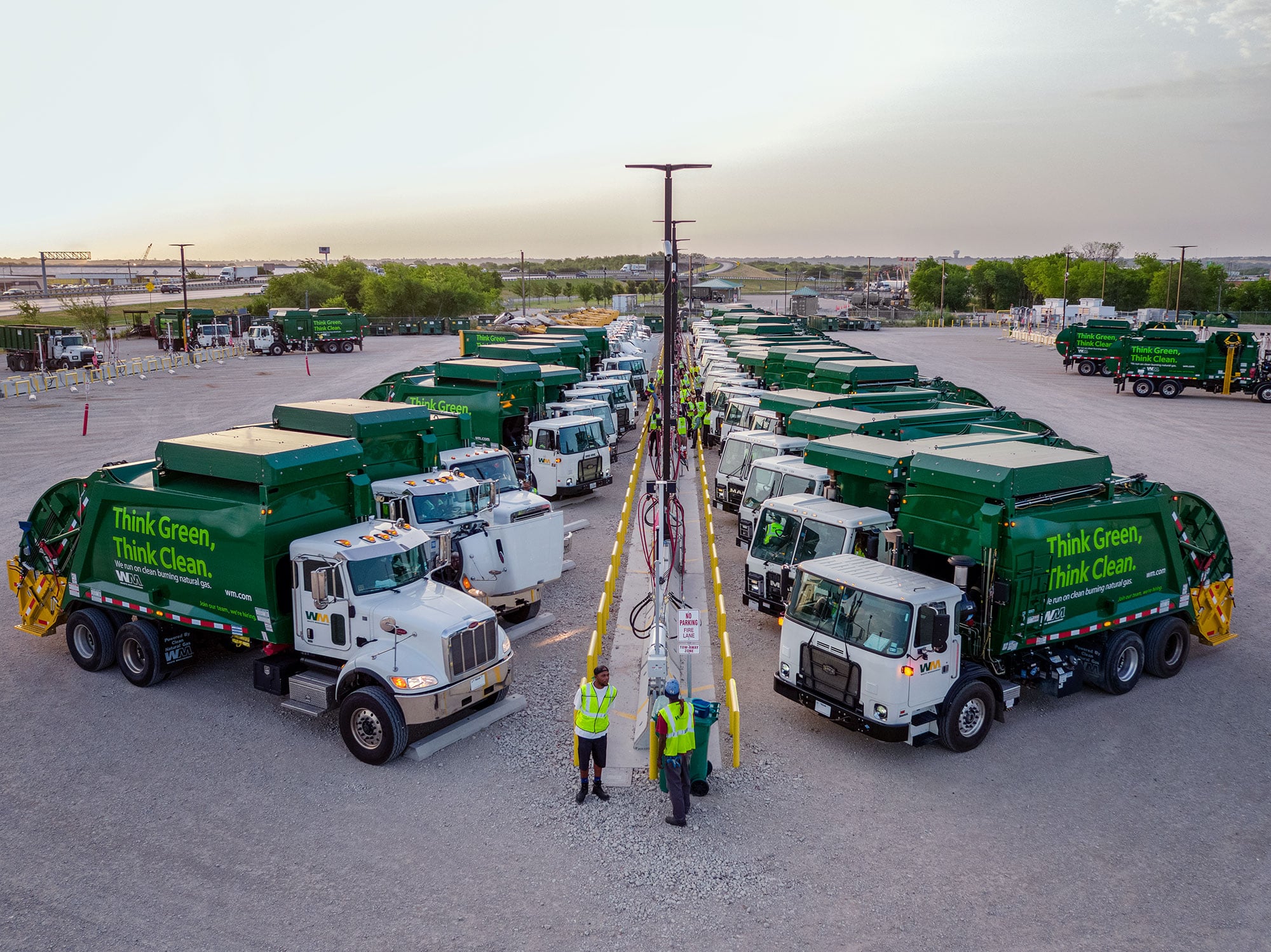
WM’s carbon footprint is comprised of anthropogenic Scope 1 (direct) and Scope 2 (indirect) greenhouse gas (GHG) emissions from facilities and activities under our operational control as well as Scope 3 (indirect) GHG emissions.
- Scope 1 emissions include direct emissions from landfills, incinerated waste, collection fleet and support vehicles, heating and refrigerants.
- Scope 2 emissions include indirect emissions from purchased energy, including electricity.
- Scope 3 emissions include purchased goods and services, capital goods, fuel and energy-related activities, upstream transport, waste, business travel, employee commuting, downstream transport, use of sold products, downstream leased assets and investments.
WM also quantifies and tracks relevant Scope 1, 2 and 3 biogenic emissions, which are reported separately from the anthropogenic GHG inventory. For our most recent GHG emissions inventory please see our Sustainability Data & Metrics, Annual Sustainability Report or Climate Brief.
Methodology
Our carbon footprint calculation relies on company operating data collected from auditable corporate business, legal and accounting records, which have undergone internal quality assurance.
WM’s inventory is calculated in line with principles and best practice methodologies recommended by the GHG Protocol and emissions factors from leading organizations such as the U.S. Environmental Protection Agency (EPA), the U.K. Department for Environment, Food and Rural Affairs (DEFRA), the International Energy Agency (IEA), and others.
WM, along with other public and private owners and operators of landfills, supported the development of the Solid Waste Industry for Climate Solutions (SWICS) protocol by SCS Engineers. The protocol represents a first step in refining existing U.S. EPA models and protocols using peer-reviewed, published research to improve landfill GHG emission estimation. We employed the SWICS protocol in estimating the emissions associated with the landfill operations reported in our company-wide carbon footprint and the voluntary GHG reporting protocols in which we participate. The U.S. EPA’s Science Advisory Board views some sources of biogenic carbon dioxide emissions — including landfill gas and biogenic materials in waste—as carbon neutral.
WM’s GHG inventory reflects the most accurate means available to calculate GHG emissions within the waste and environmental services sector. WM collaborates with industry organizations and other subject matter experts to support the ongoing development and refinement of inventory methodologies, calculation approaches and reporting protocols.
Data Governance
WM has developed and maintains an annual GHG Inventory Management Plan (IMP) that serves as an internal governance and controls document for the company’s GHG inventory. The IMP provides a framework for identifying emission sources associated with WM’s operations and applying standardized methodologies to quantify and report emissions. The process includes selecting and maintaining a base year (2021) against which future emissions are tracked, defining organizational and operational boundaries, identifying GHG emission sources for inclusion in the inventory and applying standardized and widely accepted calculation methodologies to quantify emissions.
Environmental and sustainability data are collected from, but not limited to, a variety of operational systems, business records, utility providers, vendors and other sources. To support consistency and data quality, WM utilizes centralized data management processes and standardized methodologies across its operations. Data undergo review and validation procedures designed to identify potential errors, inconsistencies and data gaps prior to inclusion in reported metrics.
Utility consumption data is managed through a centralized utility bill management process that consolidates invoices and usage information from utility providers. This process supports data completeness, facilitates quality assurance reviews and provides a consistent basis for calculating facility-related energy consumption and associated GHG emissions.
WM’s Sustainability Impact team works closely with subject matter experts and business leaders across the organization to review activity data, evaluate assumptions, apply appropriate calculation methodologies and maintain alignment with recognized reporting standards. Where complete activity data is unavailable, reasonable estimation methodologies and industry-recognized emission factors may be applied in accordance with established inventory management procedures.
GHG Inventory Data Assurance
WM conducts independent third-party assurance activities to enhance the reliability, transparency, and credibility of its environmental and sustainability disclosures. Each year, WM’s enterprise-wide GHG inventory receives limited assurance from an independent third-party verifier. To support United Kingdom (U.K.) sustainability disclosures, WM’s U.K. GHG inventory also undergoes a separate limited assurance engagement. These assurance activities evaluate reporting boundaries, GHG calculation methodologies, activity data, management systems, internal controls and reported Scope 1, Scope 2 and relevant Scope 3 emissions. Assurance activities are conducted using internationally recognized standards, including ISO 14064-3 and the GHG Protocol.
In addition to GHG emissions, WM obtains third-party limited assurance over sustainability data and performance metrics reported in our Sustainability Data & Metrics. The assurance process evaluates the completeness, accuracy and reliability of reported sustainability information, including environmental, operational, workforce, community, governance and economic performance indicators. The assessment is performed in accordance with recognized assurance standards, including ISO 14064-3, ISO 14065 and ISO/IEC 17029.
As part of these third-party assurance engagements, independent reviewers assess the processes and supporting evidence used to develop reported information. This includes reviewing data collection and aggregation processes, supporting documentation, information systems, calculation files, and other records to determine whether reported information is materially accurate and consistent with applicable reporting requirements.
Regulatory Reporting and Verification
WM participates in multiple forms of emissions verification associated with applicable regulatory reporting programs. Certain jurisdictions require independent verification of reported emissions data as part of their compliance programs. In conformance with applicable state and provincial GHG emissions reporting requirements, independent third-party verifiers review underlying data and emissions calculations and issue verification statements or certificates. Accordingly, emissions reported from landfills subject to Alberta’s GHG reporting requirements are independently verified.
WM facilities subject to the U.S. EPA Mandatory GHG Reporting Program are required to comply with established monitoring, calculation, recordkeeping and reporting requirements. Reported emissions data are subject to rigorous validation checks by the U.S. EPA as part of its compliance assurance and enforcement program.
Avoided Greenhouse Gas Emissions
WM also quantifies GHG impacts enabled by its operations that are reported separately from the Company’s GHG inventory. These impacts are not included in reported Scope 1, Scope 2 or Scope 3 emissions and are not used to offset WM’s reported emissions. Rather, they represent potential avoided emissions associated with the products and services WM provides. These impacts include:
Renewable Energy Generation: Renewable energy generated by WM can avoid GHG emissions by displacing fossil fuel-based sources of electricity and fuel. WM quantifies these avoided emissions based on the generation of renewable electricity within each electricity grid region, the use of renewable natural gas (RNG) to displace diesel fuel, and the use of medium-BTU gas to displace coal in industrial applications.
Reuse & Recycling of Materials: Recycling of post-consumer materials, such as paper, aluminum and plastics, can avoid GHG emissions by reducing the need for virgin material extraction, processing and manufacturing. WM uses the U.S. EPA’s Waste Reduction Model (WARM) to estimate the avoided emissions associated with the recycling of these materials.
Carbon Sequestration: The permanent storage of carbon in landfills occurs when biogenic materials do not fully decompose under anaerobic landfill conditions. This carbon storage can significantly offset GHG emissions from landfills and is recognized by the United Nations Intergovernmental Panel on Climate Change (IPCC), U.S. EPA, Inventory of U.S. GHG Emissions and Sinks, Oregon Climate Trust and California Air Resources Board (CARB), all of which recognize carbon storage in landfilled materials as sequestered carbon. WM uses the SWICS protocol to quantify the amount of carbon permanently stored in landfills based on organic waste disposal volumes, representing carbon that does not decompose and therefore does not generate GHG emissions.
For the most current avoided GHG emissions inventory, please see the GHG Emissions section of our Sustainability Data & Metrics.